Hi! Here I post links of interesting things I find. You can click on link below each post to go to the link.
Posts
-
The Specter Of Neuralese
Importance: 5 | # | acx
There’s a taboo on using nukes in war. If someone uses a tiny nuke, which produces an explosion no bigger than a conventional bomb, then in some sense this doesn’t matter, because it’s no worse than a conventional bomb would have been. But in another sense, it matters a lot, because you’ve broken the taboo, and now there’s only a weaker, fuzzier taboo preventing you from using a very big nuke.
So if we want a taboo on recurrence, there needs to be some specific taboo. When Pachocki says “Yes, we did recurrence, but it only added a couple of layers, so it doesn’t really matter,” this is analogous to the case where a drinker tells the police “Yes, I’m below 21, but only by a few months, so it doesn’t really matter”, or a despot tells the UN “Yes, I used a nuke, but it was very small.” It’s true that it doesn’t matter in real life, but it matters a lot for whether you can maintain a taboo or not.
-
Using Claude Code: Spending your effort
Overall, increasing effort tends to reduce failures due to missing edgecases (purple blocks), but does not fix when the model has the wrong approach (blue blocks).
Low: for when I want quick responses that are in the loop, e.g. brainstorming, sketching, easy changes
Medium: for most of my regular software engineering work, e.g. new feature implementation.
High: for work where verification is important or there are edge cases, e.g. fixing a bug in a brownfield codebase.
Max: When I want Claude to operate fully autonomously to solve difficult problems, e.g. end to end building and verification of an app, finding security vulnerabilities in critical software.
I find medium to be best for most of my build tasks with review/verify workflows running at higher efforts.
-
Why Warm Countries Are Poorer
Importance: 7 | # |
Humans evolved in the African highlands, where temperatures are stable throughout the year, and close to that of spring & fall in temperate regions. This is why we feel most comfortable there.
Close to the equator, if we’re not in the mountains, the temperatures are too high for us. We can’t think or work properly because we overheat, and our sweat can’t cool us off because humidity is too high.
We also suffer from many more diseases, more common in hot moist climates, but also because we didn’t evolve there.
A very interesting read. I also found out some things that I wasn't aware of: Opus-5.5:
Exams: Park (2022) used New York City high school exit exams, where students take tests on different days with different temperatures. Taking the exam on a hot day (around 32°C, 90°F) instead of a mild one lowered scores measurably and cut the chance of graduating. Teachers partly made up for it by bumping grades on hot exams. Pueyo's footnote 3 quotes this study.
...it's well established that heat, especially humid heat, lowers thinking and learning while you're exposed to it, and that cooling fixes most of this.
It seems likely that productivity peaks at 21-24 deg C. This sorta breaks my mental models of warmer places being better for work. I have always implicitly assumed that colder places are worse to work because you don't want to do anything - you are just content to being in bed and staying warm. I had not considered the detrimental effects of being too hot and not having a way to cool down.
-
Why you should work much harder RIGHT NOW
Importance: 5 | # | mr, tc
If strong AI will lower the value of your human capital, your current wage is relatively high compared to your future wage. That is an argument for working harder now, at least if your current and pending pay can rise with greater effort (not true for all jobs).
If strong AI can at least potentially boost the value of your human capital, you should be investing in learning AI skills right now. No need to fall behind on something so important. You also might have the chance to use that money and buy into the proper capital and land assets.
So…WORK HARDER!
Isn't this massive labour-saving technology wonderful? Now that it's finally here we can ... errr... (checks notes) Work much harder!
Tyler's argument is valid for the slow-takeoff scenario. You should weight it to your belief of P(slow-takeoff). In the fast-takeoff scenario, it seems likely that this and nothing else matters as much - you either work on alignment or enjoy life right now.
-
The Brand Age
Importance: 7 | # | pg, enshittification
Branding isn't merely orthogonal to good design, but opposed to it. Branding by definition has to be distinctive. But good design, like math or science, seeks the right answer, and right answers tend to converge.
Branding is centrifugal; design is centripetal.
Indeed it's probably a good idea not just to avoid buying brand, but to avoid selling it too. Sure, you might be able to make money this way — though I bet it's harder than it looks — but pushing people's brand buttons is just not a good problem to work on, and it's hard to do good work without a good problem.
great read.
-
Vibecession: Much More Than You Wanted To Know
Importance: 5 | # | acx
Are the youth succumbing to a “negativity bias” where they see the past through “rose-colored glasses”? Are the economists looking at some ivory tower High Modernist metric that fails to capture real life? Or is there something more complicated going on?
Scott aggregates explainations and gives his thoughts on the mismatch between the world doing better on most metrics that economists care about and the vibes being abysmal among youth.
-
Coding Workflow August 2025
Importance: 5 | # | mine, ai-coding
There's a barrage of coding-AI tools coming out every day and plenty of fancy workflows being discussed. This is my workflow as of August 2025. I primarily work on medium-sized Python codebases (~100k LOC). I also build little tools and work with small repos. Unless explicitly stated, everything here is about features/changes to larger production codebases. I'll first outline the mental models I use for coding with AI and then detail my current workflow.
Mental Model
It helps to frame the problem as optimizing work-throughput (while controlling for quality, creativity, etc.). And I have access to unlimited chimera engineers—eager to help, prone to misinterpreting context, over-engineering, assimilated all of human knowledge, ultra-fast information consumption, massive working memory, and static long-term memory... yeah lots of caveats.
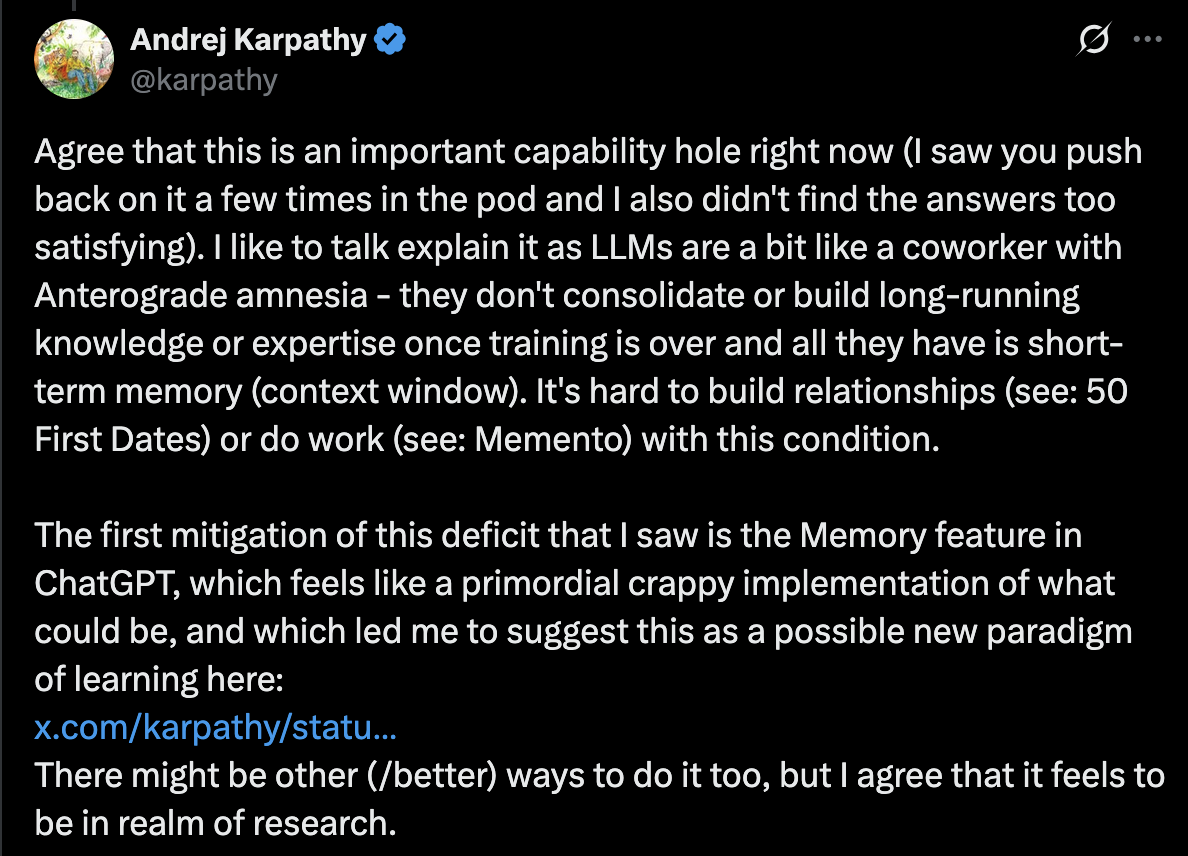
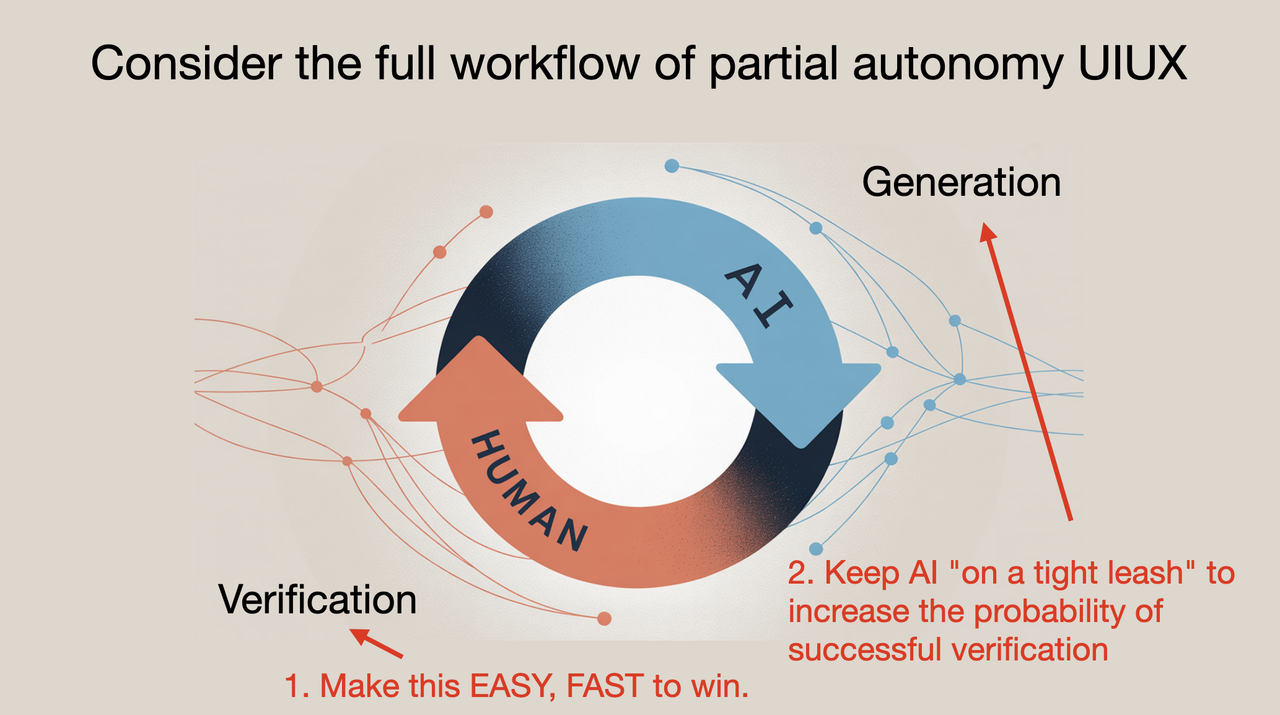
I also think of it as reducing the generation–verification gap as Karpathy puts it (notes). You have this intelligence that can generate output relentlessly; the work is then about guiding generation and verifying effectively.
Workflow
My workflow roughly follows these steps:
- Build Giant-Prompt
- Plan (no code) + my-review + iterate
- List of changes (pseudocode) + my-review + iterate
- Diffs implementation + my-review + iterate
- Iterate/test
Context is king.
My workflow is similar to what antirez suggests: I mainly use the chat interface. Given a feature/fix, I figure out the relevant context—files, functions, classes—exactly as I would without AI. I put all of this in a single Markdown file: my Giant-Prompt. If the repo is small enough I use files-to-prompt to dump the entire repo. I assimilate the context necessary to implement the change. Ask - would this be enough if I were sending this prompt to a cracked dev unfamiliar with this repo. This is obviously not a perfect analogy given that the dev will take an hour or a day to get back while the model will in <10min so you can iterate quickly, and the dev does not have phd-level knowledge in all fields. But it is close enough. This part is of course time consuming.
Once I have the Giant-Prompt, I usually pass it to two models side by side—today that's GPT-5-Thinking and Claude 4.1 Opus. First, I ask explicitly not to implement any code and instead give me an overview of how to go about solving the problem at a high level. I discuss pros and cons of design decisions and think through the simplest approach. You should be able to catch any of the major prompt fuckups and tendency for over-enginneering here. Importantly, this is where I figure out what it is that I actually want.
Imagine you have the AI implement a 1000 line diff and after 20 mins of reviewing code you find a logic error and you ask claude-code to fix it and it goes ahead and produces a 500 line diff now and you gotta review the whole thing, and you start screaming at claude as this goes on for longer than if you had just written the damn thing yourself... Might as well spend time upfront aligning the model.
Next, I ask for the list of changes that would have to be done, again not code - sometimes I ask for high level pseudocode. Starting with highlevel changes, then adjusting and subsequently getting into lower level details works best. After some iterations I ask for the implementation - list of changes to be made. Sometimes in this process I'll start fresh chats (clean context) with modified Giant-Prompt. If testing with a script makes sense, I have the model write that as well.
At this point I either make the changes myself or paste the output into claude code and have it apply the diff — no intelligence required. Then I review the diffs thoroughly, understand exactly what's happening, and own the code. I keep the chat thread/s handy at this stage and ask any questions I have, modifications to the code,...
As I review, I keep prompting the chat threads to review as well, I usually ask to look for bugs, consistency issues, logic errors, edgecases missed and gotchas. This is super useful.
This workflow might not necessarily increase throughtput by itself, but it massively helps to not just sit around or scroll through twitter while the response is being generated. There's always shit to do (even without context switching) during the generation time - reading detailed outputs, reading code, thinking through, reading the other AI's output...
I tried agents (mainly Claude Code), really tried. It's not that they don't work; it's that the output-to-effort ratio isn't there yet given today's capabilities and scaffolding. They're great for vibe-coding where you don't need to read the code and can just run things. The tools do not do justice to the intelligence/capabilities of the models - they read files in little chunks and struggle. It is not the best way to get things done right now - more hand holding and supervision is required. The models need to be kept on a tighter leash.
Tools
These are the tools I mainly use:
- GPT-5-Thinking, GPT-5-Pro, Claude 4.1 Opus for chat (rarely Gemini 2.5 Pro now that GPT-5 has a 1M context window, kinda sad personally for me, 2.5-pro was a beast of an upgrade in march).
- Cursor — just for Cursor Tab. I never use the Cursor agent. Cmd+K is occasionally useful, but I almost always go to the chat interface.
- Claude Code/Codex (only to do basic things or understand codebase)
A lot of people shoot themselves in the foot expecting AI to read their mind. In a way they lack empathy for the AI (understandably), if one puts some effort into imagining what it would really be like to not know anything specific to you or your problem statement, that itself would go a long way.
Building intuition for what a model will nail versus what will trip it up is super useful and comes from time spent with the models. Good investment to make, no wall in sight.
-
What Is Man, That Thou Art Mindful Of Him?
Importance: 5 | # | acx, ai
God: …and the math results we’re seeing are nothing short of incredible. This Terry Tao guy -
Iblis: Let me stop you right there. I agree humans can, in controlled situations, provide correct answers to math problems. I deny that they truly understand math. I had a conversation with one of the humans recently, which I’ll bring up here for the viewers … give me one moment …
When I give him a problem he’s encountered in school, it looks like he understands. But when I give him another problem that requires the same mathematical function, but which he’s never seen before, he’s hopelessly confused.
Funny and beautiful.
-
Mass Intelligence
Importance: 4 | # | ethan-mollick, openai, ai
There have been two barriers to accessing powerful AI for most users. The first was confusion. Few people knew to select an AI model. Even fewer knew that picking o3 from a menu in ChatGPT would get them access to an excellent Reasoner AI model, while picking 4o (which seems like a higher number) would give them something far less capable. According to OpenAI, less than 7% of paying customers selected o3 on a regular basis, meaning even power users were missing out on what Reasoners could do.
Another factor was cost. Because the best models are expensive, free users were often not given access to them, or else given very limited access. Google led the way in giving some free access to its best models, but OpenAI stated that almost none of its free customers had regular access to reasoning models prior to the launch of GPT-5.
GPT-5 was supposed to solve both of these problems, which is partially why its debut was so messy and confusing. GPT-5 is actually two things. It was the overall name for a family of quite different models, from the weaker GPT-5 Nano to the powerful GPT-5 Pro. It was also the name given to the tool that picked which model to use and how much computing power the AI should use to solve your problem
-
Are OpenAI and Anthropic Really Losing Money on Inference?
Importance: 4 | # | llm
I'm only going to look at raw compute costs. This is obviously a complete oversimplification, but given how useful the current models are - even assuming no improvements - I want to stress test the idea that everyone is losing so much money on inference that it is completely unsustainable.
Martin makes some rough calculations - starting with deepseek V3 as baseline and taking into account hourly rate of H100s and assuming bandwidth bound process (3.35 TB/s HBM badnwidth) - calculates number of forward passes per second. Two seperate calculations for prefill and decode stage and here's the outcome:
The asymmetry is stark: $144 ÷ 46,800M = $0.003 per million input tokens versus $144 ÷ 46.7M = $3.08 per million output tokens. That's a thousand-fold difference!
Of course the prefill stage can become compute bound at long context lengths.
These costs map to what DeepInfra charges for R1 hosting, with the exception there is a much higher markup on input tokens.
By these numbers, there is good chance that even the claude-max plan for claude-code users are running at a 10x markup for heavy users - costing $20 and charging $200.
One interesting point here is how Anthropic and OpenAI differ in their approach to models. Judging for raw token speed, my guess would be that Claude models are larger but token efficient (Opus 4.1 barely thinks and is competitive with say GPT-5-thinking-high), whereas GPT5 without thinking (minimal) is a pretty dumb model and for high quality outputs it thinks forever. If each output token is so costly, and OpenAI was supposedly optimizing for inference cost - wouldn't they have gone for a model like Claude? One explanation is that these estimates are assuming MOE model with like 5% active parameters, it could be that Claude is either much higher active params or not MOE at all. It will be interesting to see what approach people take moving forward - Anthropic doesn't need to optimize for inference as much as OpenAI - no free users.
More here.
Say hello.